
Nikro Air Duct Cleaning in Upland: A Homeowner’s Guide
Nikro air duct cleaning in Upland means the company you hire runs a HEPA-rated negative air machine, not a shop vac with a long hose. The difference matters because duct cleaning only works if dislodged debris is actually captured and contained while the system is under suction. If you’d rather skip the research and get straight to a clean system, call (855) 382-4830 for a free estimate.
If a technician tells you they use “professional equipment” but can’t tell you the filtration rating or airflow capacity of their extraction unit, that vagueness is itself diagnostic information. Real equipment has real specs. And in Upland, where homes range from 1970s slab-foundation ranches to newer two-story builds, the equipment has to match the house.
What Nikro Equipment Actually Is
Nikro Industries manufactures HEPA-filtered negative air machines and portable extraction units built for containment work. The spec that matters most is the filtration rating: 99.97% of particles at 0.3 microns. That’s the HEPA standard, and it’s the same benchmark used in hospital isolation rooms and mold remediation containment. When a duct cleaning crew agitates years of accumulated dust, pet dander, and sometimes mold spores inside your ductwork, the extraction unit is the only thing standing between that debris and your living room air. A HEPA-rated unit captures it. A consumer-grade vacuum does not, and a shop vac absolutely does not.
We run Nikro equipment on residential jobs in Upland because the housing stock here demands it. Slab foundations mean ducts often run through tight, awkward chases. Crawlspaces, where they exist, are low and hard to access. Portable Nikro units get into positions a truck-mounted system physically cannot reach, and they maintain negative pressure at the point of extraction rather than relying on a long hose run that loses suction with every foot.
Here’s what the HEPA rating means in practical terms:
- Particles down to 0.3 microns are trapped, including mold spores, fine dust, and allergens that pass right through standard filters
- The machine exhausts cleaner air than it takes in, which matters when it’s running inside your home during cleaning
- Filter change documentation proves the unit was actually doing its job, not just making noise
How Negative Air Pressure Containment Works
The principle is straightforward, and it’s the dividing line between a real cleaning and a cosmetic one. Before any agitation begins, the duct system must be placed under negative pressure. That means the extraction unit is pulling more air out of the system than can flow back in through the registers. When that balance is achieved, any debris dislodged during brushing gets pulled toward the extraction point. The airflow only moves one direction: out of your ducts and into the HEPA filtration.
When negative pressure is not established, the opposite happens. Agitation tools knock debris loose, and without directional airflow pulling it toward extraction, that debris drifts. It settles back into the duct runs. It puffs out of registers into bedrooms and hallways. It gets stirred up and redistributed rather than removed. This is the mechanism behind the horror stories homeowners in Upland tell us about duct cleanings that made their houses dustier. The company didn’t fail to clean; they failed to contain.
Nikro negative air machines are purpose-built for this. They’re designed to run continuously for hours at a stretch, holding steady negative pressure while the actual mechanical agitation happens. A consumer vacuum motor burns out under that load, which is why cheap operators don’t hold containment, they just move fast.
Why Extraction Is Only Half the Job
This is the part most duct cleaning marketing skips: extraction equipment captures debris, but it doesn’t dislodge it. Dust that has accumulated for a decade is often compacted, adhered to duct walls by humidity cycles, or matted around register boots. You need mechanical agitation to break it free before the negative air machine can pull it out.
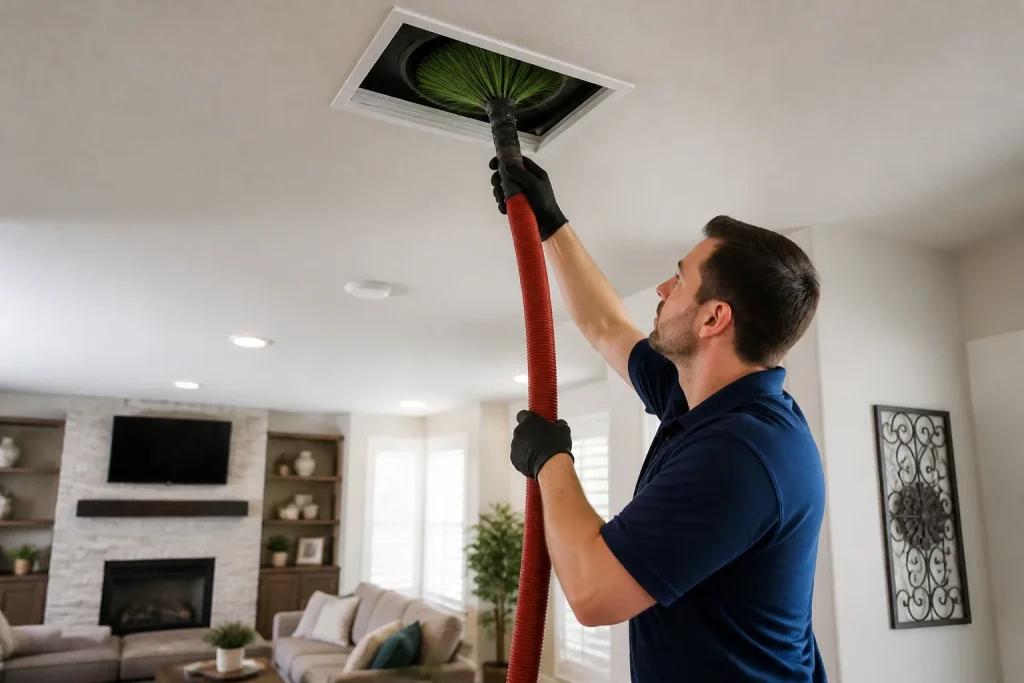
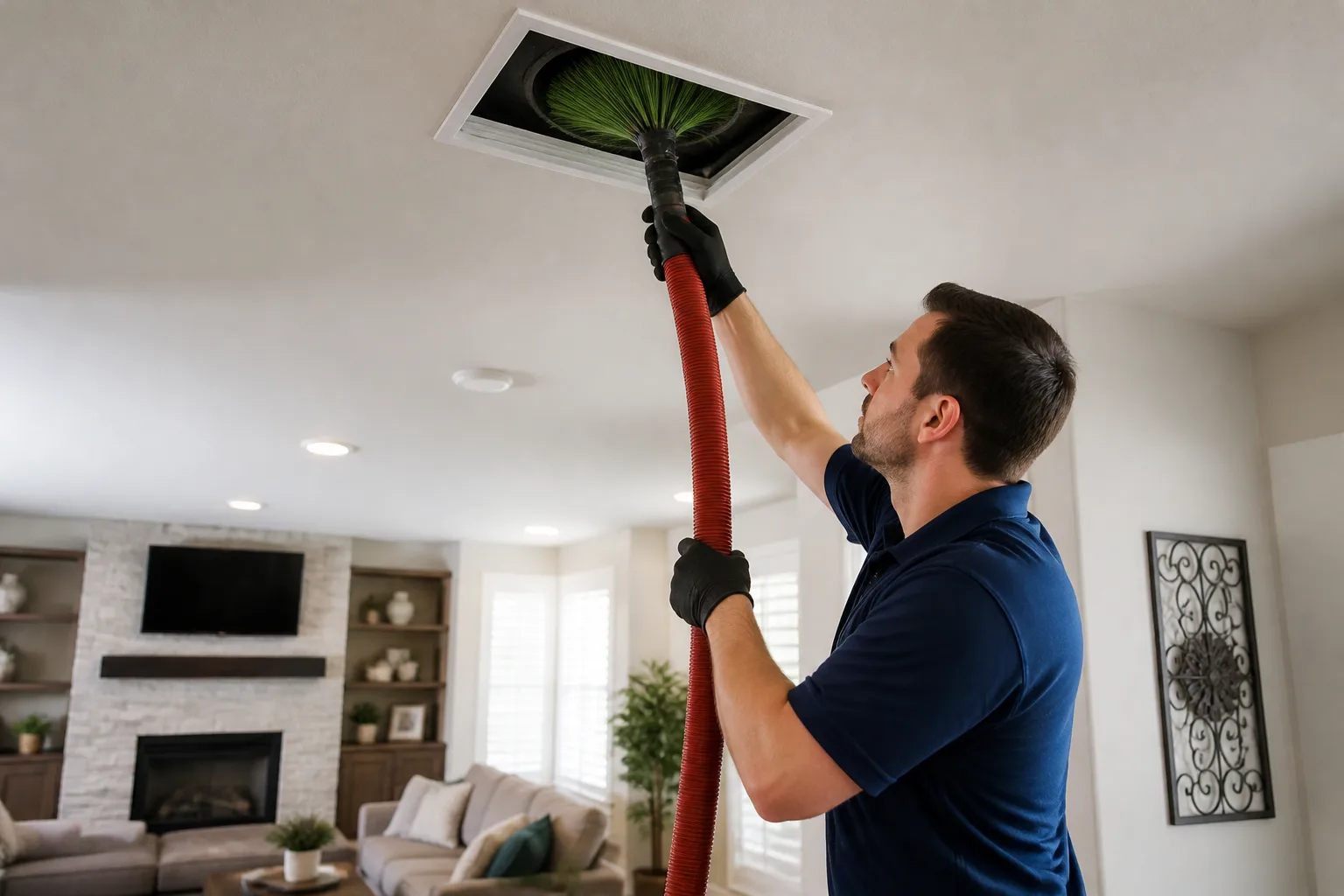
That’s where air duct cleaning equipment like Rotobrush enters the picture. Rotobrush systems use rotating brush heads that physically scrub the interior surface of duct runs. The brushes break the bond between debris and ductwork. The Nikro unit, running negative pressure the entire time, captures everything the brushes release. One without the other is incomplete. A brush with no extraction just makes dust airborne inside your home. Extraction with no agitation leaves the bonded debris exactly where it was.
Upland homes built in the 1980s and 1990s often have ductwork that has never been cleaned since installation. That’s thirty to forty years of accumulated material. It does not come off with suction alone, no matter how powerful the vacuum. The combination of mechanical agitation and HEPA-rated negative air extraction is what actually removes the load.
Nikro Portable Units vs. Truck-Mounted Systems
There’s a persistent assumption that bigger equipment means better cleaning, and truck-mounted systems get marketed on that basis. The reality is more nuanced, and it matters specifically for Upland’s housing stock.
Truck-mounted systems pull enormous airflow, but they do it from the street or driveway. The suction travels through a long hose run into your home and connects to the duct system. Every foot of hose introduces friction loss. On a two-story Upland home with the furnace in a hallway closet, that hose run can be sixty to eighty feet. The “massive suction” at the truck is significantly reduced by the time it reaches the ductwork.
Portable Nikro units operate differently. The machine comes inside, positioned as close to the extraction point as possible. Hose runs are short. Suction at the duct is far closer to what the unit produces at the machine. For slab-foundation homes where ductwork runs through inaccessible chases, a portable unit placed at the plenum or main trunk delivers better performance than a truck-mounted system parked two rooms away.
Truck-mounted has its place, generally on very large commercial systems or when the duct runs are unusually extensive. For the typical Upland single-family home, a properly deployed portable Nikro extraction unit matched with a Rotobrush agitation system is the better tool. This is one reason we invite homeowners to look at the equipment when we arrive. You should be able to see what’s actually being used, not just take someone’s word for it.
Questions to Ask Any Company Claiming Nikro Equipment
“Nikro” is a brand name with a strong reputation, which means some operators borrow the name without actually owning or maintaining the equipment. You have every right to verify. These are the questions that separate a legitimate operation from a marketing claim:
- What’s the model number of the extraction unit? Nikro makes specific models with defined CFM ratings. A company using the equipment should know what they run.
- Can you show me the filter change documentation? HEPA filters have a service life. A company that tracks filter changes is actually maintaining their equipment. One that can’t show you records is either not changing filters or not running the equipment they claim.
- Are your technicians trained on negative pressure setup? Running the machine is easy. Establishing and holding proper negative air pressure while managing register sealing and agitation is a skill. Ask if the crew has formal training on containment setup.
- Will the unit be visible during the cleaning? A legitimate operator has no reason to hide the equipment. You should be able to walk out and see the Nikro unit running.
These questions are not confrontational. They’re the same questions you’d ask a mechanic about parts quality or a contractor about materials. In Upland, where the difference between a real cleaning and a wasted appointment can be measured in indoor air quality for months afterward, they’re worth asking.
When to Call a Pro
Duct cleaning is not a DIY project, full stop. The equipment required is not available at rental counters, and attempting to clean ductwork with consumer tools risks damaging the ducts themselves. Flex duct tears easily. Sheet metal seams can separate. And once a duct system is damaged, the leak introduces attic air, crawlspace air, or wall-cavity air into your breathing space, which is worse than the dust you were trying to remove. If you’re seeing visible dust buildup at registers, noticing musty odors when the system runs, or dealing with allergy symptoms that spike indoors, the answer is a professional with proper containment equipment, not a weekend project.
Related services in Upland: dryer vent cleaning is a separate and equally serious concern. Lint accumulation is a leading cause of residential fires, and dryer vents need dedicated cleaning with proper airflow verification, not a quick pass with a brush. Duct Cleaning Upland handles both, plus air duct repair for systems where the structural integrity of the ductwork itself is the problem.
The Bottom Line
Nikro equipment matters because it provides HEPA-rated filtration and true negative air pressure containment, the two things that separate a real duct cleaning from a cosmetic one. The equipment is portable, which suits Upland’s slab-foundation housing stock and tight mechanical spaces. It works best paired with mechanical agitation like Rotobrush, because extraction captures what brushes dislodge. And you can verify it by asking for model numbers, filter records, and training documentation.
If you’re in Upland and want the job done with real containment equipment, air duct cleaning from our team includes a full system assessment and written estimate before any work begins. Call (855) 382-4830. We answer 24/7. Fast dispatch from 7am to 7pm, Sunday through Friday.
Frequently Asked Questions
Yes, because Nikro units are HEPA-rated negative air machines with verified filtration specs, while many residential operators use consumer-grade vacuums or truck-mounted systems with long hose runs that lose suction. The HEPA rating of 99.97% at 0.3 microns means the unit captures mold spores and fine particulates that other equipment recirculates into your home. Ask any company to show you the equipment and its filter documentation.
For a typical Upland single-family home, expect three to five hours depending on the number of systems, accessibility of duct runs, and how heavily loaded the ducts are. Homes with slab foundations and tight mechanical closets can take longer because access is more difficult. The written estimate you receive before work starts will set the scope and price, so there are no surprises once the job begins. Call (855) 382-4830 for a free estimate.
No, when operated correctly by trained technicians. The negative air machine itself only pulls air; it cannot damage ducts. Agitation tools like Rotobrush are designed for use inside residential duct systems, and the brushes are sized to the duct dimensions. Damage occurs when untrained operators use improvised tools or excessive force. That’s another reason to ask about training and equipment before you hire anyone.
Reputable companies provide before-and-after photos of the duct interior so you can see the results yourself. You should also expect a post-cleaning walkthrough where the technician shows you the access points, explains what was removed, and verifies that registers were properly sealed back in place. Combined with filter change documentation on the extraction unit, you’ll know the work was real. Call (855) 382-4830 to schedule an assessment in Upland.
Written by the team at Duct Cleaning Upland, serving Upland since 2012.
Need Air Duct Cleaning Help?
Call Duct Cleaning Upland - licensed & insured, with free written estimates in Upland.
(855) 382-4830